Saturday, 21 May 2016

Mutual Funds Versus ULIP

In this article you will be able to understand how beneficial it is to have remained invested in Mutual Fund versus ULIP

For our example, Lets take Example of ICICI Pru Guaranteed Wealth Protector Plan 
Didn't that word "GUARANTEED" immediately appeals you, and we prefer to invest in avenues where the principal amount is safe. It may not be wise, but that's our immediate reaction when asked about investing. But that is where we are wrong and many insurance agents even doesn't know what does the term guaranteed means 

Lets go ahead with our Example 
ICICI Pru Guaranteed Wealth Protector Plan is a ULIP plan where you have premium paying term of 1 year and 5 years with a lock in period of 5 Years.
In case if you paid a premium for 5 Years then Sum Assured is 10 times and for Single Premium it is 1.25 Times.
ICICI Pru Guaranteed Wealth Protector Plan will be investing 60% in Equity Market and 40% in Debt Market with Life Growth & Life Income Fund respectively which would be reduced to 90% in Debt & 10% in Equity at the end of 10th year that is maturity year 
You will get tax benefits on premiums paid as per section 80C so in our comparison we would also include a Tax Savings (Balanced) Mutual Fund
Illustrations

Annual Premium : Rs 1,00,000 
Sum Assured     :  Rs 10,00,000
Age at Entry       :  35 Years 
Model of Premium Payment : Annual 
Premium Paying Option : 5 Years 
Assured Benefit at Maturity : 5,05,000

Now Let us calculate the charges levied by fund 
Premium Allocation Charges are 6%,5%,4%,4% in annual premium payment mode for 1st , 2nd , 3rd , 4th and 5th year respectively , After 5 Years there are no charges 
Policy Administration Charges are from 1st to 5th year 0.21% p.m. (2.52% p.a) and from 5th year onwards 0.10% (1.20% p.a)
there is also a charge called Fund Management Charge which is adjusted against NAV 
Below are the details for units accumulated


Nav for ICICI Pru Guaranteed Wealth Protector - Life Growth Fund as on 20/05/2016 is 13.09

Below are the details for units accumulated


Nav for ICICI Pru Guaranteed Wealth Protector - Life Income Fund as on 20/05/2016 is 12.5512

 
Fund Value as on 20/05/2016
13889.33 X 13.09 = Rs 181,811
9901.14 X 12.512 = Rs 123,883
Total                     = Rs 305,644
Since you paid 3 years premium amount to Rs 3 Lakhs and currently your fund value is 305644 a gain of Rs 5644 and XIRR 6.39% p.a. along with an insurance of 10 Lakhs 


If we buy only mutual funds then we wont be able to cover the insurance part, since insurance is not an investment but a risk mitigation tool we would go ahead with Term Insurance for a male aged 35 years and rest would be invested in SIP in Birla Sun Life Tax Relief 96 (Growth Fund).  I have written an article on "How much insurance do i need" which would help you to select the exact insurance amount
Well, The reason for selection of Birla Sun life tax relief is, it is a Tax Savings and Balanced fund with target allocation of 80%equity & 20% debt and money market securities.

Mutual-Fund-Versus-ULIP

From the above image we had to pay a premium of Rs 5254/- p.a + service tax 761.83 = Rs 6,015 every year 

We would be investing 
1,00,000 (Original Premium)
-   6,015 (Term Insurance Premium) 
=93,985 divide by 12 i.e 7,832 rounding off Rs 7800 in SIP


In ULIP you would have paid premium every 1 year and SIP you pay monthly , but remember you are paying your premium advance to Insurance Companies and that is not the case in SIP and logically you are losing Interest on the premium amount paid initially to insurance companies.

SIP Calculation is below where in we would have paid 210600 for 27 months and our investment value appreciated to Rs 237828 as on 20/05/2016

Remember : We haven't purchased units of Rs 1 Lakhs in third year instead we are going with SIP mode that is the reason our investment is still below 3 Lakhs compared to ULIP.

Below is the calculations where every year we have purchased a lump sum of Rs 93,985 for Birla Sun life tax relief fund
 

from the above sheet it is clearly visible that Mutual Funds Versus ULIP, MF always have an upper hand 

I hope you enjoyed reading the article , it takes time to write  articles with facts and figures, request you to please spread the word. A good way to start is to share this page on your social circle using floating social share bar on the left.

Who doesn't like a financial healthy life,In case if you want one contact me for Financial Planning, please do drop an email to me at vipuls1979@gmail.com. I would be happy to assist you


Mutual Funds & Insurance Related Articles :-

Benefits of SIP
What is SWP in mutual Funds
Best 3 Large Cap Mutual Funds for SIP in India
Best 3 Midcap Mutual Funds for SIP in India

Top 3 ELSS TAX Savings Funds for SIP in India
Why you should not buy ULIP
How to Select Mutual Fund for Portfolio
Liquid Funds are better alternative than Savings Bank account
What is FMP in Mutual Funds
Complete Guide on Monthly Income Plans
Complete Guide on Credit Opportunities Fund
How to Save Tax using Equity Linked Savings Scheme
How to Budget Your Money
How Much Insurance Do You Really Need
Why Should you buy Term Insurance Upto 60 Years
5 Must Have Insurance Policies for Women

 
Equities related article :
What is Power of Attorney in Online Trading?

Futures & Options related article :


In case of any further explanation you can reach me on vipuls1979@gmail.com or tweet me @vipuls1979
Disclaimer  :-


The Article is only for information purposes and Vipul Shah (https://investkiyakya.blogspot.com) is not providing any professional/investment advice through it. The article does not constitute or is not intended to constitute an offer to buy or sell, or a solicitation to an offer to buy or sell financial products, units or securities. https://investkiyakya.blogspot.com disclaims warranty of any kind, whether express or implied, as to any matter/content contained in this article, including without limitation the implied warranties of merchantability and fitness for a particular purpose. https://investkiyakya.blogspot.com and its subsidiaries / affiliates /
sponsors / trustee or their officers, employees, personnel, directors will not be responsible for any direct/indirect
loss or liability incurred by the user as a consequence of his or any other person on his behalf taking any
investment decisions based on the contents of this guide. Use of this article is at the user’s own risk. The user must
make his own investment decisions based on his specific investment objective and financial position and using
such independent advisors as he believes necessary. https://investkiyakya.blogspot.com does not warrant completeness or accuracy of any information published in this guide. All intellectual property rights emerging from this article are and shall remain with https://investkiyakya.blogspot.com. This article is for your personal use and you shall not resell, copy, or redistribute this article , or use it for any commercial purpose. All names and situations depicted in the article are purely fictional and serve the purpose of illustration only. Any resemblance between the illustrations and any persons living or dead is purely coincidental.


Wednesday, 4 May 2016

How Much Insurance Do I Need

Life Insurance acts as an important tool in wealth creation for an individual helping him achieve long and short term financial goals.


Everyone Needs Insurance,But the problem is many doesn't know how much Insurance is required, whether they are under insured or over insured. More ever people think Insurance is more of an Investment rather than a mere Risk Mitigation tool.


Insurance should only be purchase for earning member of the family. I have personally seen many insurance agents selling child insurance plans which is an utter non-sense

The problem actually is with the insurance agents who rather then securing your life due to unforeseen event, look for hefty commissions from Insurance companies and forces you to purchase  Endowment policy or Money Back policy or child plans or Unit Linked Insurance Plans and what not.

Every Individual should go ahead with a term insurance policy which is a perfect fit to cover risk. Few Insurance agent's would suggest you for term insurance as commissions are too low because premiums are too low.

Let me help you with an Illustration 
Mr Sharma , aged 35 years , Married and having 2 children , earning a gross income of Rs 10 Lakhs , post tax income is taken as Rs 58,333 per month.
Mr Sharma has an LIC policy of Rs 10 Lakhs
Imagine if due to sudden demise of Mr Sharma , His Nominee Mrs Sharma will receive Rs 13 Lakhs (Assuming accumulated bonus of Rs 3 Lakhs) from LIC
If Mrs Sharma would keep this money in a Fixed Deposit at 12% (higher side) interest rate then yearly interest would be Rs 156,000.
Let us divide Rs 156,000/12 to arrive at monthly income = Rs 13,000
Imagine an Net Income of Rs 58333 is suddenly reduced to Rs 13000

Simple formula for how much Insurance required is
(Gross Income/ Current Interest Rate offered by Banks )* 100
In Mr Sharma's case he would have required an insurance of 
10 Lakhs / 8 *100 =1.25 Cr

Mr Sharma already had an insurance of Rs 10 Lakhs with LIC and he needs to insure another 1.15 Cr 
If Mr Sharma had to investment in Money Back or Endowment Policy premium would have been around 5 Lakhs a year which is not feasible and the returns are mere 6% which doesn't even beat inflation.
Mr Sharma should opt for a Term Insurance Policy of Rs 1.15 Cr resulting in safeguarding his family in case of sudden demise 
Lets do the maths now 

Rs 11500000 ( Term Insurance ) + Rs 13 Lakhs
LIC Policy (Including Bonus)= 1.28 Cr 

1.28 Cr / 8% = Rs 10.24 Lakhs Yearly Interest Rate Income
Rs 10.24 Lakhs / 12 = Rs 85,333

His Nominee Mrs Sharma would receive Rs 85333 every month assuming an interest rate of 8% in bank fixed deposit which would not only take care of her household expenses but also higher education for both kids.

In the next article i would write about how to achieve wealth with term insurance plus mutual fund , wait for the same folks and i hope you enjoyed reading the article 

PPS: If you think this page and blog will be useful to any of your friends please spread the word. A good way to start is to share this page on your social circle using floating social share bar on the left

Mutual Funds & Insurance Related Articles :-

Benefits of Systematic Investment Plan
What is Systematic Transfer Plan and How it works ? 
Advantages of Equity Linked Savings Schemes
Top 3 Mutual Funds to Invest in 2016 for Long Term
How Much Insurance Do I Need ?
How to Select Mutual Fund for Portfolio ?

How to Budget your money with 40/30/30 Rule ?
Mutual Fund Versus ULIP 

Why Term Insurance Policy is required till 60 years ?

Equities related article :
What is Power of Attorney in Online Trading?

Futures & Options related article :

In case of any further explanation you can reach me on vipuls1979@gmail.com or tweet me @vipuls1979

Disclaimer  :-


The Article is only for information purposes and Vipul Shah (https://investkiyakya.blogspot.com) is not providing any professional/investment advice through it. The article does not constitute or is not intended to constitute an offer to buy or sell, or a solicitation to an offer to buy or sell financial products, units or securities. https://investkiyakya.blogspot.com disclaims warranty of any kind, whether express or implied, as to any matter/content contained in this article, including without limitation the implied warranties of merchantability and fitness for a particular purpose. https://investkiyakya.blogspot.com and its subsidiaries / affiliates /sponsors / trustee or their officers, employees, personnel, directors will not be responsible for any direct/indirectloss or liability incurred by the user as a consequence of his or any other person on his behalf taking any investment decisions based on the contents of this guide. Use of this article is at the user’s own risk. The user must make his own investment decisions based on his specific investment objective and financial position and using such independent advisors as he believes necessary. https://investkiyakya.blogspot.com does not warrant completeness or accuracy of any information published in this guide. All intellectual property rights emerging from this article are and shall remain with https://investkiyakya.blogspot.com. This article is for your personal use and you shall not resell, copy, or redistribute this article , or use it for any commercial purpose. All names and situations depicted in the article are purely fictional and serve the purpose of illustration only. Any resemblance between the illustrations and any persons living or dead is purely coincidental.

Wednesday, 3 February 2016

How is Daily & Historical volatility calculated?

Understand Volatility

The most important parameter “Volatility” in the trading and investment is often neglected by the traders. Only few statistical indicators in the technical study consider the volatility as a key parameter in their combination. Volatility also informs well in advance how the price is going to behave in the near future. The dynamic price action of a financial instrument whether it is a stock or currency or future always follows the internal volatility in it.

The most appropriate and common definition I have derived for the volatility is, “The annualized standard deviation of the price change”. The standard deviation is a statistical calculation and most beautiful work available in the branch of statistics.

At this point you may ask “How the volatility is going to bother you?” Volatility in the financial mathematics is often treated as a discouraging word. The financial translation of the word volatility says, “The risk associated in the investment over a particular time”. When the analyst in the business channel broadcast the news that market is currently volatile we all anticipate something risky. The most general view the trader concludes that “doing the business in the stock or in the financial instrument will increase the risk of failure”. However the fact and the truth reveals that none of those broadcasters have an appropriate scale to measure and inform us a correct number on volatility before pressing the panic button.

Volatility is classically defined as a powerful untrained horse which has all capacity to win the race if trained properly. Same time the powerful horse has the capacity to kill his rider if not guided properly.

Definition of volatility - “it is the risk associated with the price at a particular time”
Mathematical definition - “the annualized standard deviation of the price change”


How to calculate volatility?

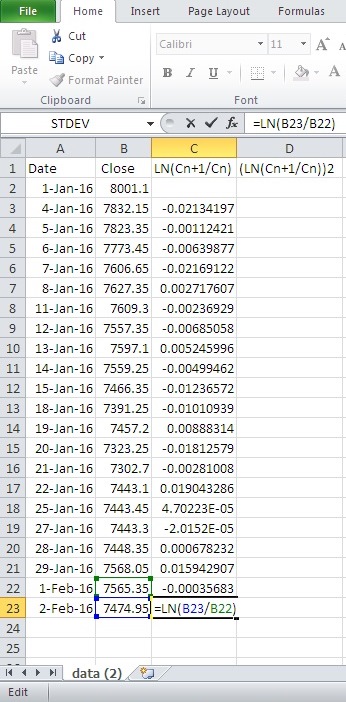
1. Estimating the volatility based on the periodic return: In this method we need to calculate the periodic return of the price change and calculate the daily volatility using the standard deviation formula. Below are the steps involved in calculating the daily volatility based on the periodic return. 
I have calculated volatility for NIFTY on 02/02/2016 based on past 1 month data from 01/01/2016 till 02/02/2016. We would compare our manually calculated volatility with NSE NIFTY volatility at the end.

Step 1 :- Find the periodic return by using LN (current price/previous price) as shown in image below
Daily-and-historical-Volatility-Calculation

Continue to calculate log returns till the end 
Daily-and-historical-Volatility-Calculation

Step 2 :- Take periodic return square as shown below 
Daily-and-historical-Volatility-Calculation

Continue to calculate log returns till the end as shown below 
Daily-and-historical-Volatility-Calculation


 Step 3:-  Arithmetic average of the periodic return
Daily-and-historical-Volatility-Calculation

Step 4 :-  Arithmetic average of the square periodic return

Daily-and-historical-Volatility-Calculation


Step 5 :- Variance= Arithmetic average of the square periodic return- (Arithmetic average of the periodic return)2 
Daily-and-historical-Volatility-Calculation

Step 6 :- Daily volatility = Square root of (Variance) 
How-to-calculate-daily-volatility

Step 7 :- Annual volatility = daily volatility X square root of (Number of days in a year)
How-To-calculate-historical-volatility

Final Calculation as shown below
Daily-and-historical-volatility

NSE NIFTY Volatility shown in below image as on 02/02/2016


If you observe our calculation for Daily Volatility i.e 1.044 vis-a-vis Nifty Daily volatility i.e 1.05 , it is almost similar and 
Manually Historical Volatility calculated i.e 19.96 vis-a-vis NIFTY annualised volatility i.e 20 is the same , if we round off 19.96 to nearest value.

You may also download the excel sheet below for your future reference

Help other by sharing the post if you like

Equities related article :
What is Power of Attorney in Online Trading?

Futures & Options related article :